
How to Play Truth or Dare: Rules, Setup & Tips
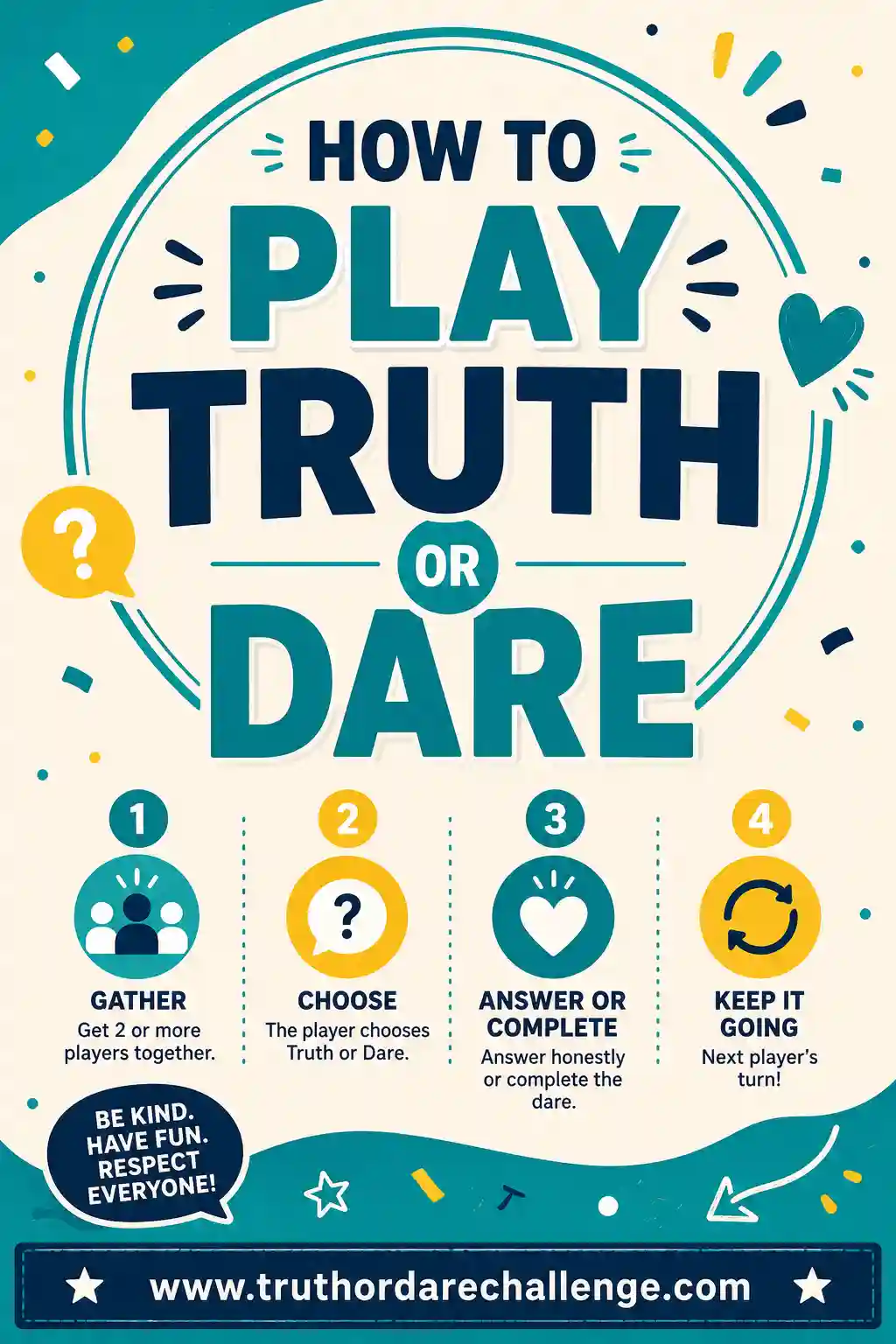
To play truth or dare, players take turns choosing "truth" or "dare." If they pick truth, they answer a question honestly. If they pick dare, they do a small challenge. You go around the circle, one person picks for the next, and the game keeps rolling for as long as everyone's having fun. That's the whole game in one breath. The fastest way to start is to skip the prep and let our free Truth or Dare game pick the prompts for you.
Want to jump straight in? Open the free game, gather your friends, and tap "Truth" or "Dare" when it's your turn. No sign-up, no app, no fee. Or read on for the full rundown, from setup to turn order to the little tricks that keep a game alive.
The Basic Rules of Truth or Dare
Truth or dare has almost no rules, which is exactly why it's lasted for generations. Here's the short version.
On your turn, you choose one word: truth or dare.
- Pick truth and someone asks you a question. You have to answer honestly.
- Pick dare and someone gives you a challenge. You have to attempt it.
If you complete your truth or dare, play moves on. If you refuse, most groups use a small "forfeit" (more on that below). Then it's the next person's turn to choose. That's really all there is to it. The magic is in the questions and dares you use, not in a complicated rulebook.
A few things worth agreeing on before you start:
- Honesty counts. The game only works if truths are answered truthfully. If someone obviously fibs, the group can call it.
- Dares stay safe and kind. No dare should be dangerous, mean, or something a person genuinely doesn't want to do.
- A "pass" option is fair. Let people skip one prompt they're not comfortable with. It keeps the game fun instead of stressful.
What You Need to Play
Almost nothing, which is part of the charm. You can play truth or dare anywhere: a living room, a backyard, a car, a video call, or a tent at summer camp.
Here's the full list of "equipment":
- At least two people. More is more fun, but two works fine.
- A list of prompts (or our free game to generate them for you).
- Somewhere to sit in a circle so everyone can see and hear each other.
That's it. No board, no cards, no batteries. If you want a bank of ready-made questions, our master list of truth or dare questions has hundreds sorted by group and mood.
How to Set Up the Game
Setting up takes about thirty seconds. Follow these steps and you're ready to play.
- Get everyone in a circle. A circle means every player can see who's up next and hear the questions clearly.
- Agree on the vibe. Decide as a group whether you're keeping it silly and light, or going a little bolder. Match the prompts to the crowd.
- Set your boundaries. Quickly agree on any "off-limits" topics. Two seconds now saves an awkward moment later.
- Choose who goes first. Youngest player, whoever's birthday is next, or a quick round of rock-paper-scissors all work.
- Decide on a forfeit. Pick a light penalty for anyone who chickens out (a silly one is best).
Once that's settled, you're playing. Don't overthink it. The setup should take less time than deciding what to watch on TV.
Turn Order: Who Asks Whom
This is the part people fumble, so let's make it clear. There are two common ways to run turns, and both are correct. Just pick one and stick with it.
The "player to your left" method
The person whose turn it is chooses truth or dare, and the player to their left gives them the question or dare. Then turns rotate around the circle. Simple and fair, since everyone eventually asks and answers.
The "winner picks" method
Whoever just finished their turn chooses the next player and gives them their truth or dare. This version is livelier because you can playfully target the friend who's been getting off easy. Just make sure nobody gets picked on too much.
For big groups, the "player to your left" method keeps things orderly. For close friends who like to tease, "winner picks" is more fun. If you're playing our free Truth or Dare game, it handles the prompts, so you only have to decide who's up next.
How to Pick Great Truths and Dares
The game is only as good as the prompts. A boring "what's your favorite color?" kills the mood, and a dare that's too wild makes people uncomfortable. Aim for the middle.
Good truths are:
- Specific ("What is the most embarrassing thing in your search history?" beats "Tell us a secret").
- A little revealing, but not cruel.
- Easy to answer on the spot.
Good dares are:
- Doable in the room you're in.
- Silly more than scary.
- Over in a minute or two.
Here's a quick sample you can steal:
| Truths | Dares |
|---|---|
| What was your most embarrassing school moment? | Do your best runway walk across the room. |
| Who was your first celebrity crush? | Talk in a cartoon voice until your next turn. |
| What is a habit you have that annoys people? | Let the group choose your next texting reply. |
| What is the last white lie you told? | Do your best impression of another player. |
| What is a silly fear you still have? | Sing "Happy Birthday" like an opera singer. |
Want more ideas sorted by type? Browse our good truths list for questions and pair them with dares from the game.
What Happens If Someone Refuses
Every group needs a plan for the player who won't do a dare or answer a truth. This keeps the game moving and stops one person from stalling everyone.
The classic solution is a small forfeit, agreed on before you start. Pick something light and funny, not a real punishment. A few crowd favorites:
- Take a "silly selfie" the group gets to keep.
- Wear a goofy accessory (a paper hat, socks on hands) until their next turn.
- Answer two truths in a row next time.
- Do a 10-second silly dance.
The point of a forfeit isn't to be harsh. It's a gentle nudge so people commit, plus a laugh for everyone else. And always keep a "pass" in your back pocket for anything that truly crosses a line. A game should feel safe.
Tips to Keep the Game Fun
A great game of truth or dare has a rhythm. Here's how to keep yours going strong.
- Read the room. If energy dips, throw in a big, silly dare to reset the mood.
- Balance truths and dares. If everyone keeps picking truth, add a rule that you can't choose the same option twice in a row.
- Keep it moving. Don't let one turn drag. If a dare stalls, move on.
- Match the crowd. Kids, teens, adults, and mixed families all need different prompts. Our party guide has crowd-specific ideas.
- End on a high. Stop while people still want more, not when they're bored. It leaves everyone wanting a rematch.
The best games end with someone saying "one more round." That's your sign you did it right.
Common Mistakes to Avoid
A few small missteps can flatten an otherwise fun game. Steer clear of these.
- Dares that are too extreme. Anything dangerous or mean isn't a dare, it's a problem. Keep it playful.
- Vague truths. "Tell us something" gets a shrug. Be specific to get a reaction.
- No boundaries set. Without a quick agreement upfront, someone eventually feels cornered. Sixty seconds of setup prevents it.
- Picking on one person. Spread the turns around. Nobody should feel like the target.
- Letting it run too long. Even a great game gets stale after an hour. Quit while it's still fun.
Frequently Asked Questions
How many people do you need to play truth or dare?
You need at least two players, but the game shines with three to eight. With a small group you get more turns each; with a big group there's more variety and energy. Our free game works for any size because it generates prompts for whoever's up.
Who goes first in truth or dare?
Any fair method works: the youngest player, whoever has the next birthday, or a quick round of rock-paper-scissors. Some groups let the host go first to set the tone. It genuinely doesn't matter, so pick something quick and start playing.
Can you play truth or dare with just two people?
Yes. With two players you simply take turns asking each other. It's a favorite for couples, siblings, and best friends. Because it's more intimate, the questions tend to go deeper, which many people love. We have a whole guide to truth or dare for two people if that's your setup.
What if someone doesn't want to do a dare?
Give them a light forfeit agreed on beforehand (a silly dance, a goofy hat) or let them "pass" once. The goal is fun, not pressure. A good group always respects a genuine no and moves on without making a big deal of it.
Is truth or dare appropriate for kids?
It can be, as long as you keep the prompts clean and age-appropriate. Stick to silly dares and lighthearted questions. Our free game and article lists keep everything PG, so it's safe for family game night, sleepovers, and classrooms.
Do I have to answer truthfully?
Yes, that's the one real rule of the game. A truth only counts if it's honest. If you're not comfortable answering, it's better to take the dare or use your pass than to lie, since fibbing ruins the fun for everyone.
Ready to Play Truth or Dare?
Now you know the rules, the setup, the turn order, and the little tricks that keep a game alive. The only thing left is to play. Open the free Truth or Dare game, gather a couple of friends, and let it pick your prompts so you can focus on the fun. It's free, there's no sign-up, and you'll be laughing within the first round. Go on, tap "Truth" or "Dare" and see where the night takes you.